
The complete guide
How to Choose a Silk Sleep Mask That Actually Blocks the Light
The problem is smaller than you think
Most people who sleep badly blame noise, stress or the mattress. Light gets less attention, partly because you are asleep when it happens and partly because a room that looks dark at 10pm is a different room at 5am in summer.
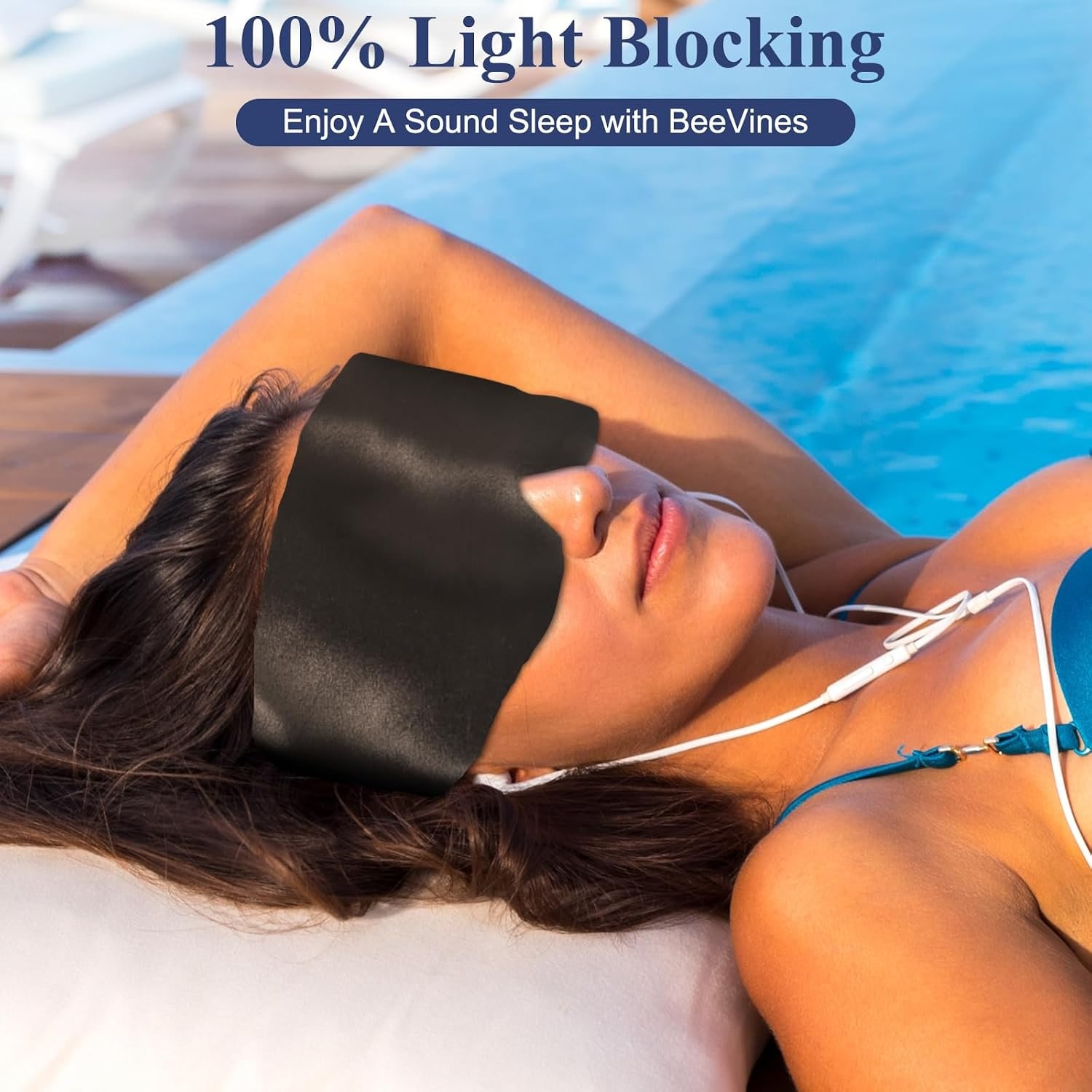
Your eyelids are not opaque. Even closed, enough light passes through to register, and that is the signal your body uses to decide the night is over. A streetlight through a 2 cm gap in the curtains, a partner's phone screen, the standby glow on a television, a dawn that arrives before five in December. Any of these can pull you out of deep sleep without fully waking you. You remember it as waking up tired, not as waking up because of light.
A sleep mask solves this in the most direct way possible. It puts the dark right against your face so the rest of the room stops mattering. The trick is that a bad mask creates its own problems, and that is worth understanding before you buy.
Why most cheap masks fail
Pick up a budget mask and you will usually find three things. The fabric is thin polyester satin, which looks silky and feels slippery for about a week. The shape is a flat rectangle. And the strap has a plastic slider or buckle at the back.
The flat rectangle is the real issue. Your face is not flat. The bridge of your nose pushes the fabric up and away, and that leaves an open triangle on each side. Point a torch at it and you will see light pour straight in. That is why people wake at sunrise even wearing a mask.
The buckle is the second issue. You do not feel it when you put the mask on sitting up. You feel it at 3am when you roll onto your side and a hard plastic lump is pinned between your skull and the pillow. People take the mask off, then blame the mask for not working.
The third issue is friction. Cheap satin grips skin and lashes. You move, it drags, you half wake, you adjust it. Repeat that six times a night and the mask has cost you more sleep than it saved.
What 22 momme means in practice
Silk is sold by momme, written as mm but nothing to do with millimetres. It is a weight measurement, the same idea as GSM for cotton. Higher momme means more silk fibre in the same area of fabric.
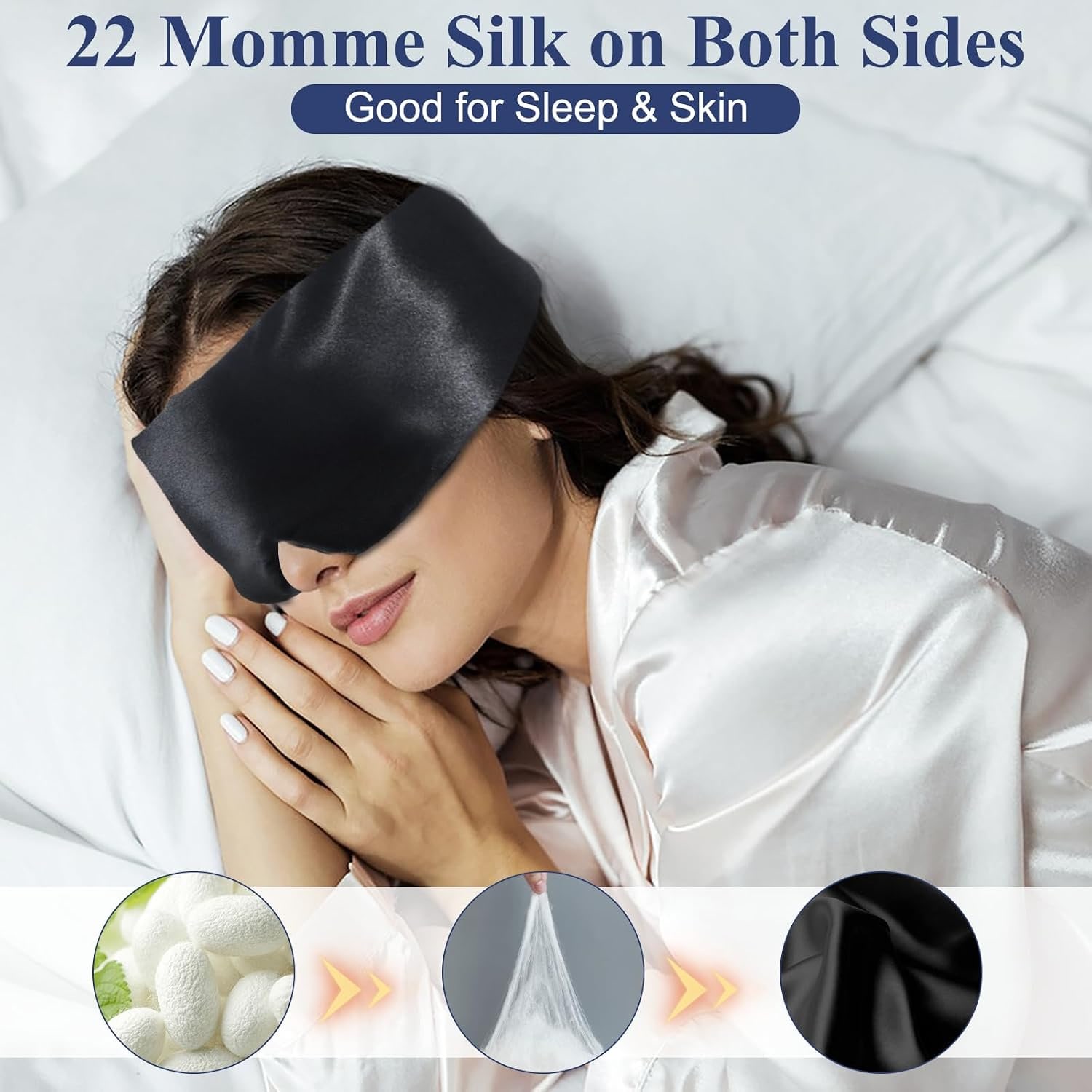
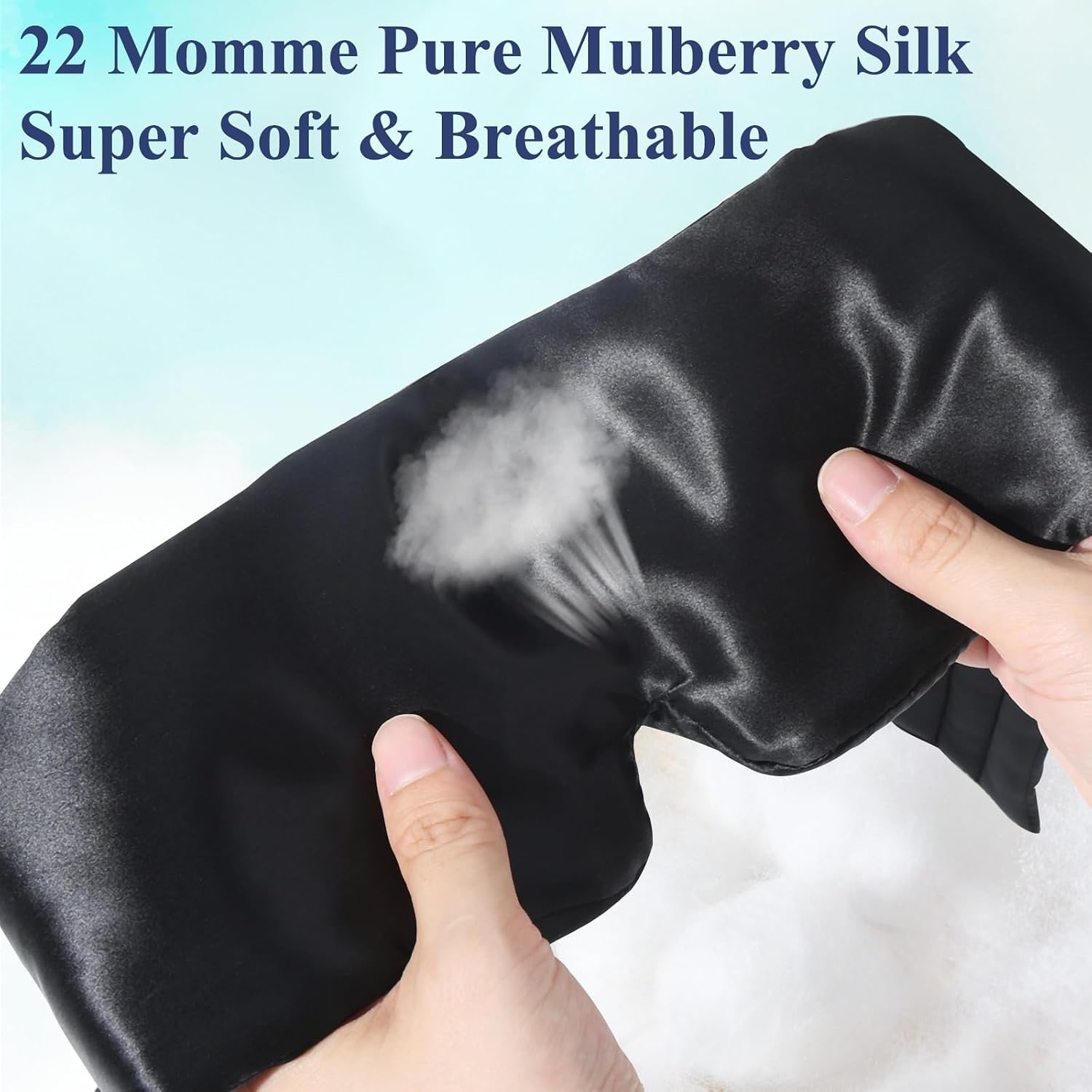
Thin silk sits around 12 to 16 momme. At 22 momme you get noticeably more body. The fabric has enough weight to settle over the contours of your face rather than tenting across them, and it is dense enough that light does not pass through the weave. Put a 22 momme panel over a lamp and compare it with a thin one, the difference is obvious.
Weight also changes how it ages. Denser silk takes washing and nightly handling better. A flimsy mask goes limp and starts looking tired within a couple of months, where a heavier one keeps its shape.
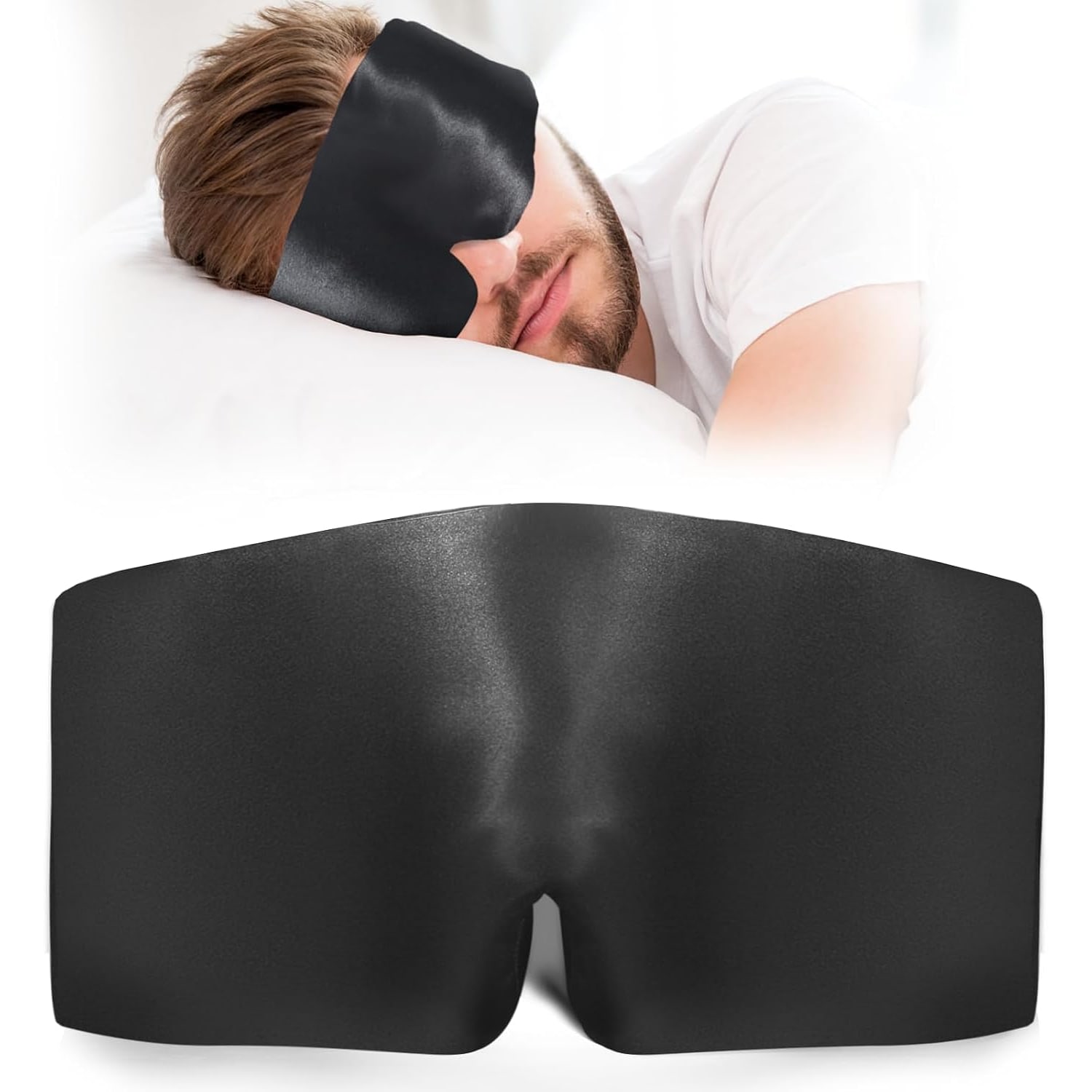
This mask is 22 momme mulberry silk on both faces, which matters more than it sounds. Plenty of masks use nice silk on the outside and something cheaper against the skin, where it actually touches you. Here both sides are the same, and the filling inside is silk as well rather than synthetic wadding.
The nose pad does the heavy lifting
If you only check one thing when comparing masks, check the nose.
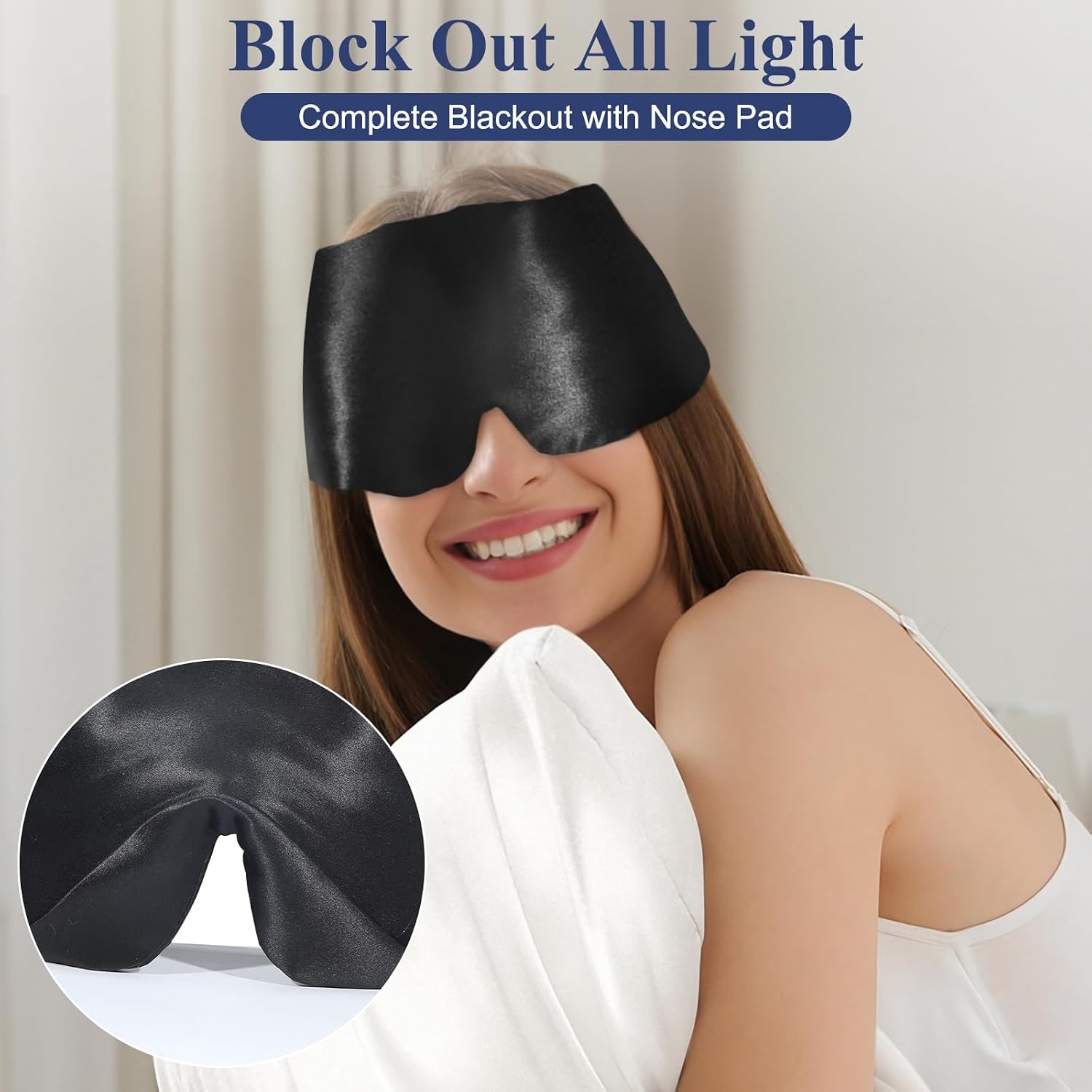
A shaped nose pad is a small moulded section along the lower edge that follows the bridge of your nose. It fills the gap that a flat mask leaves wide open. Done well, it seals without clamping, so you are not getting pressure on the bridge of your nose or on your eyelids.
The other half of the equation is the band. A wide cushioned band spreads the load over a bigger area of your face, which is why you can wear it for eight hours without a red line across your temples. Narrow elastic bands do the opposite, concentrating all the tension in a thin strip.
Between the two, the mask holds a light seal with gentle pressure instead of tight pressure. That is the whole design goal of a good blackout sleep mask.
Fit, and why hook and loop wins
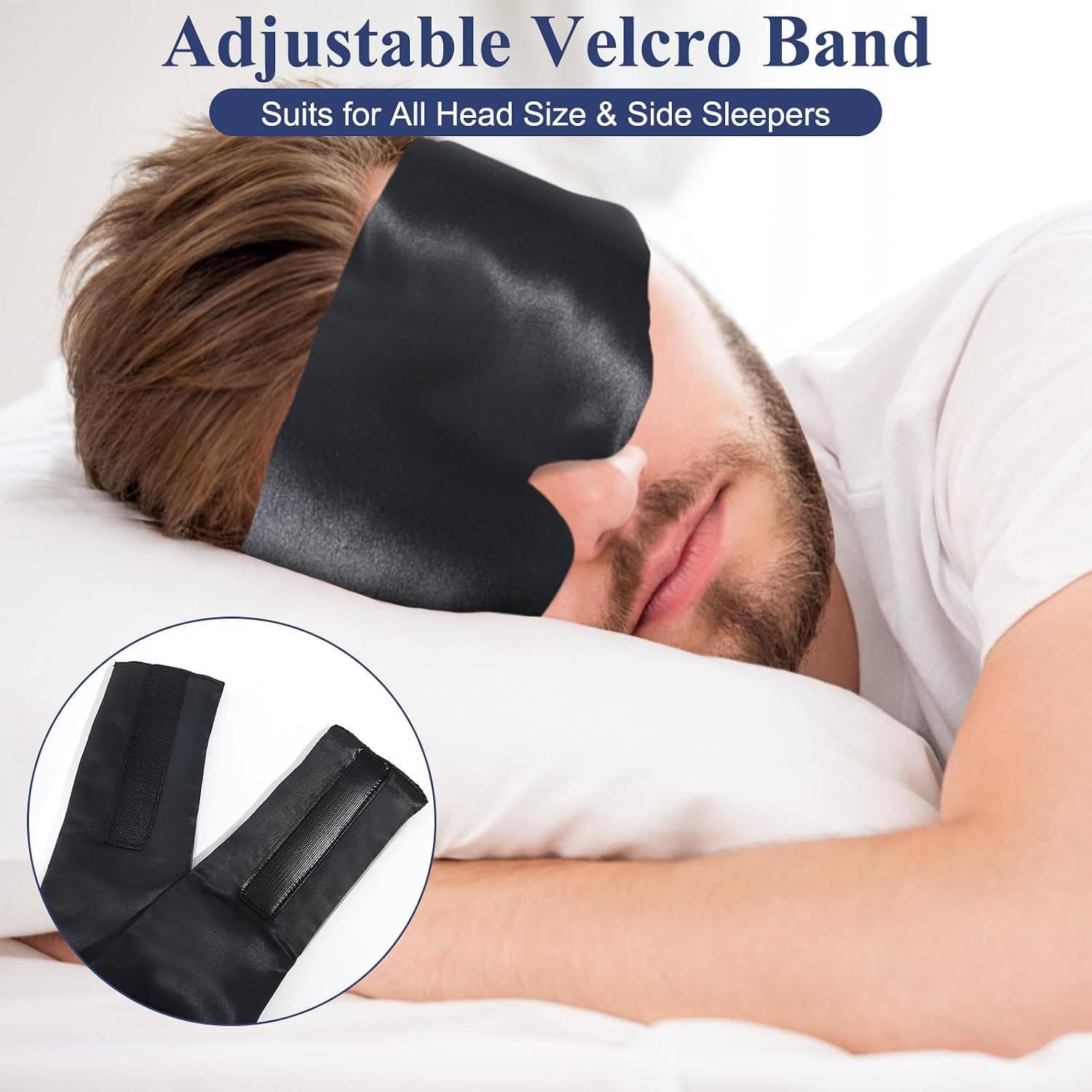
The strap on this one uses hook and loop fastening. You set the length once, press it closed, and it stays where you put it. No buckle, no slider, no knot.
That is a quiet advantage for side and tummy sleepers. There is nothing rigid on the back of your head, so rolling over does not create a pressure point. It also means you can run it looser for a daytime nap and tighter for a noisy overnight flight without hunting for the right elastic position.
When you first fit it, do it lying down rather than standing at a mirror. Your face shape shifts slightly when you lie back. Seat the nose pad first, then draw the strap to the point where the mask is sealed but you cannot feel it pulling. If you can see a sliver of light at the nose, nudge the mask down a few millimetres before you tighten further. Most light leaks are a positioning problem, not a tension problem.
Who it suits
Light sleepers are the obvious group, but the mask earns its keep in a few other situations.
Shift workers sleeping through the afternoon get the most dramatic improvement, since curtains rarely handle midday sun. Frequent flyers like it because at roughly 60 grams it adds nothing to a carry-on. Anyone sharing a room with a different schedule, a partner who reads late or a baby monitor glowing on the nightstand, gets a simple fix for someone else's light.
It is also useful for a short daytime reset, for meditation, or for lying down when a headache makes bright rooms unpleasant. An adjustable silk eye mask is easy to loosen for twenty minutes and tighten again at night.
It is an adult mask, so it is not the right choice for a small child.
Looking after it
Silk is a protein fibre, so treat it closer to wool than to cotton.
Hand wash in cool water with a gentle detergent made for silk or delicates. Skip bleach entirely, do not leave it soaking, and never wring it. Press the water out between a clean towel, reshape the mask while it is damp, then dry it flat and out of direct sun. Heat and strong sunlight are what dull silk over time.
One small habit makes a real difference. Close the hook-and-loop strap before washing. If it is left open, the rough side will catch on the silk and pull tiny threads.
Washing every week or two is sensible for something worn against your face nightly, and more often if you use rich night creams. Let it dry completely before the next use.
The short version
Light is one of the easiest sleep disruptions to remove, and a mask does it without a single change to your room. What separates a good one from a frustrating one comes down to four things: enough fabric weight to stop light passing through, a shaped nose pad to close the gap beside your nose, a wide band so pressure spreads out, and a strap with no hard parts to lie on.
This mask covers all four. It is 22 momme mulberry silk on both faces with silk filling, a moulded nose pad, a cushioned band and a hook-and-loop strap you set once. It is black, it weighs about 60 grams, and it folds flat enough to live in a bag.
If you sleep lightly, work nights, travel often or simply get woken by a sunrise you did not ask for, it is a small purchase that changes something you notice every single morning.