
The complete guide
How To Choose A Silk Pillowcase That Actually Fits Your Pillow
The problem with most pillowcases
Most of us never think about what our face spends eight hours pressed against. We buy a set of sheets, the pillowcases come with them, and that is the end of it. Then one morning you catch yourself in the mirror with a crease running diagonally across your cheek, or your hair looks like it lost an argument overnight, and you start wondering whether the fabric has something to do with it.
It does. Woven cotton, even good cotton, has a surface with real texture to it. Under a microscope the fibres are short and they stick out in all directions. When you turn your head during the night, your hair and skin drag across that texture. Over one night it is nothing. Over a few thousand nights it adds up to a lot of small tugging.
Silk is a different animal. The filament is long, smooth and continuous, which is why the cloth feels the way it does. Things slide over it. That is the entire pitch, and it is a simple one, but it is the reason people who switch rarely go back.
What the numbers on a silk pillowcase actually mean
Shopping for silk means running into a few terms that do not come up anywhere else in bedding. Here is what they mean in plain words.
Momme is the weight of the cloth. It is an old Japanese measure and it works a bit like GSM does for cotton. For pillowcases, anything under 16 momme is thin enough that you will notice, and anything over about 25 starts to feel heavy and costs a lot more. This case is 19 momme, which sits in the comfortable middle. It has enough body to drape nicely over a pillow and hold a shape, without the stiffness you get at the heavy end.
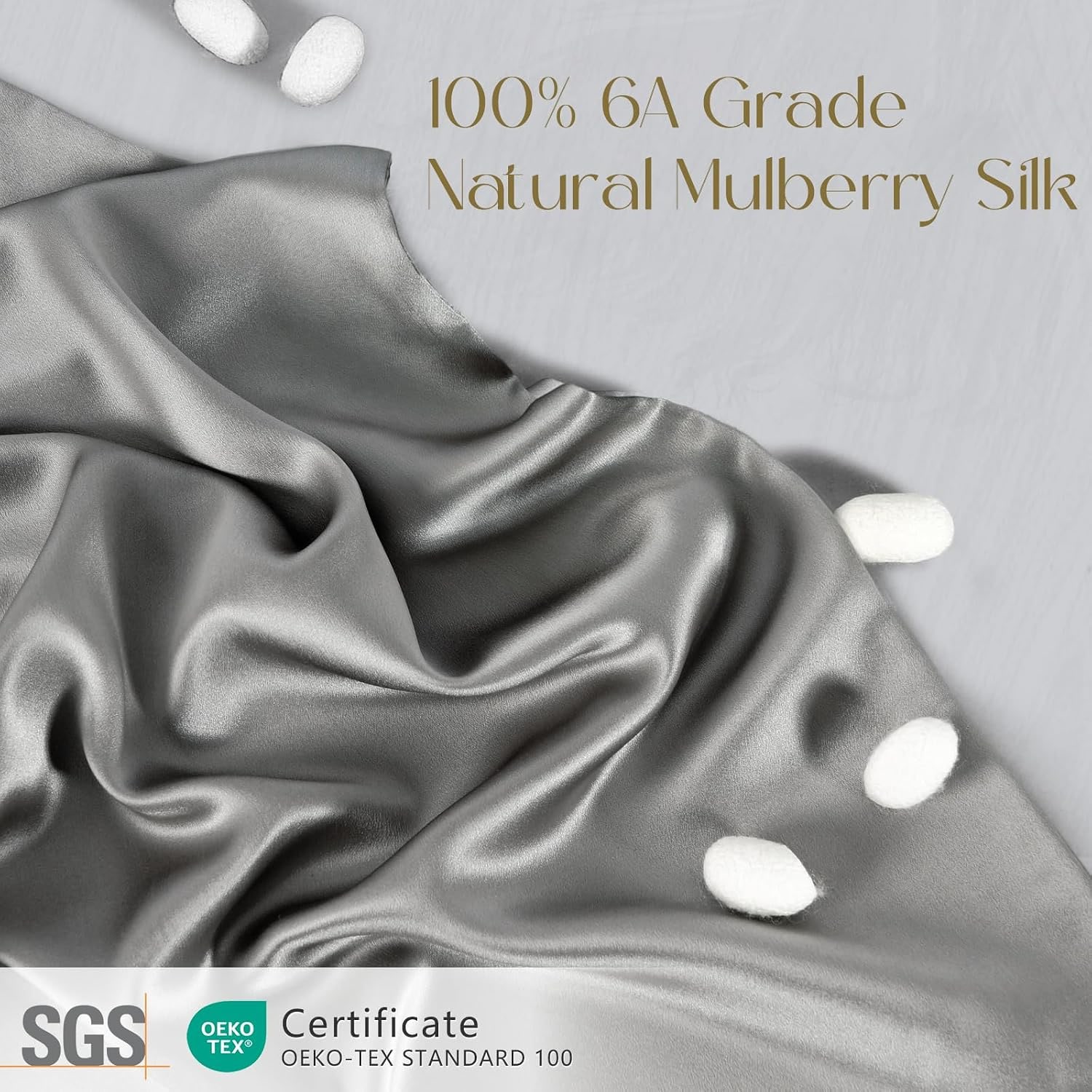
Grade describes the quality of the raw filament before it is woven. The scale runs from A at the bottom to 6A at the top, and it measures things like how long the fibre is, how even its thickness is, and how free it is of defects. Grade 6A is the top of that scale. In practice, a higher grade means a smoother, more even surface with a more consistent sheen.
Thread count gets a lot of attention in cotton and rather less in silk, because momme already tells you most of what you need. Still, 600 indicates a fine, tightly woven cloth. When you are comparing options, look at momme first and treat thread count as supporting information.
Double-sided is worth checking on every listing. A fair number of cheaper pillowcases use real silk on the face and something else underneath, usually a polyester satin or a cotton blend. You cannot tell by looking at a photo. This one is pure silk on both faces, which means it wears evenly and it does not matter which way the pillow lands.
Size is where most people get caught out
This is the part worth slowing down for. Silk pillowcases are almost always cut to American sizing, which does not match what a South African pillow usually measures.
American standard runs about 51 by 66 cm. American queen is roughly 51 by 76 cm. American king is around 51 by 91 cm. Meanwhile a typical South African pillow is somewhere near 45 by 70 cm, which falls between the American standard and queen.
This case is 75 cm long by 50 cm wide, listed as Queen 20 by 30 inches. Put a 45 by 70 cm pillow inside it and you will have a bit of slack at the end. Most people find that looks perfectly normal and feels soft, because the extra fabric gathers gently rather than pulling tight. If you prefer a snug, tailored look with no loose fabric, the fit will be looser than you want.
So measure. Lay the pillow flat on the bed, do not squash it, and run a tape from edge to edge along both the length and the width. Note the depth too, because a thick memory foam pillow eats into the usable length of any case. Then compare against 75 by 50 cm and decide whether that works for you. Two minutes with a tape measure saves a return.
Why the zip matters more than you would think
Pillowcases close in one of three ways. An open end is the simplest, an envelope flap tucks the pillow in behind a fold, and a zip seals it shut.
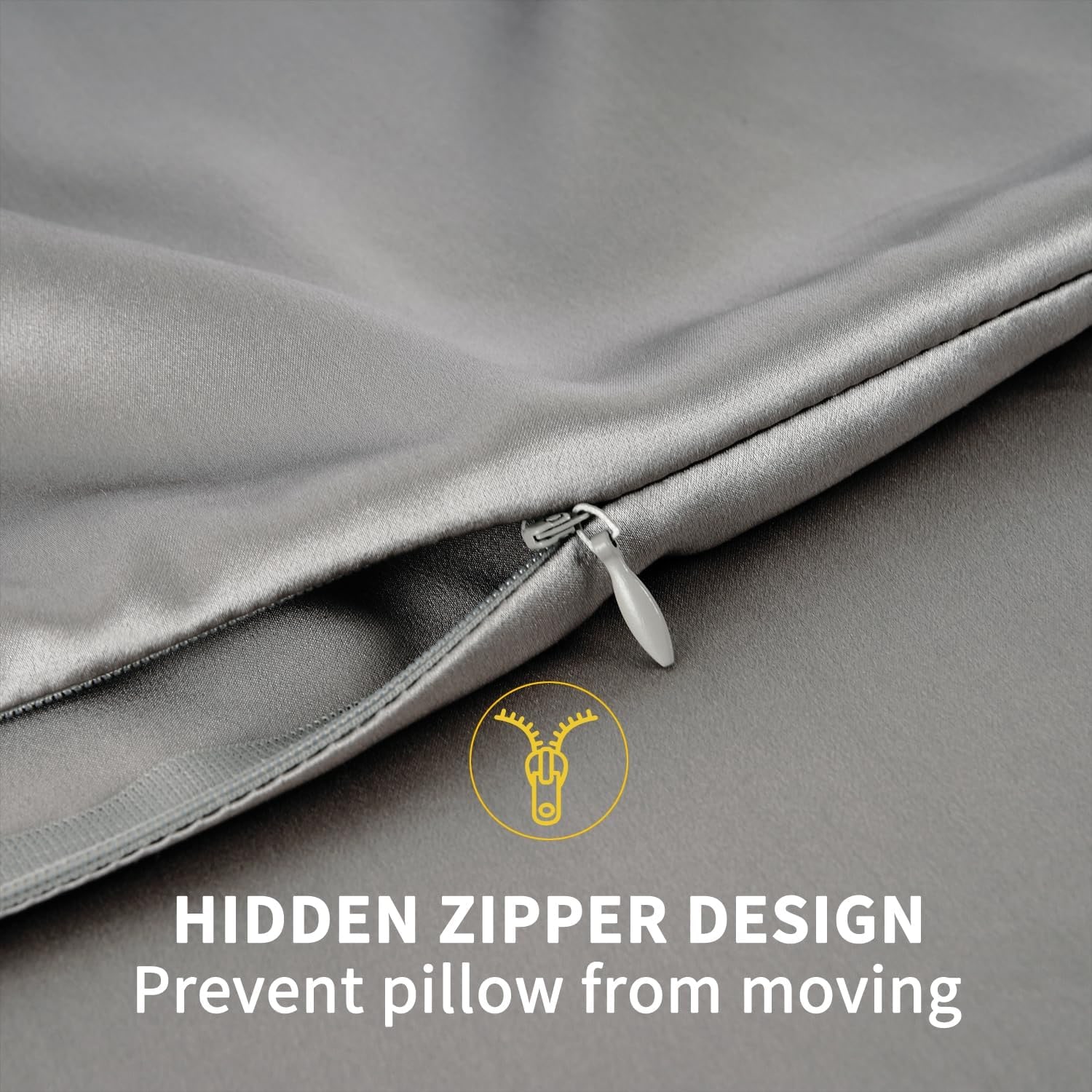
Open ends and envelope backs both have the same weakness. If you move a lot at night, or if your pillow is on the firm side, the pillow slowly works its way towards the opening. You wake up with a corner of bare pillow against your cheek, which rather defeats the point of buying a silk pillowcase in the first place.
A hidden zip solves that. The pillow stays where you put it, the case keeps a neat rectangular shape, and the zip itself tucks away out of sight along the side edge. You will not feel it while you sleep because it does not run across the sleeping surface. The one habit to build is closing the zip before you wash the case, so the teeth cannot catch the weave while it is moving around in the water.
Who this suits
People with long hair or curls tend to notice the difference fastest, because that is where friction does the most visible work. Anyone who sleeps hot often likes silk too, since it feels cool when you first lie down. If you use night creams or hair oils, silk absorbs less of them than cotton does, which means more of what you applied stays where you put it.
It also just feels good. That is a perfectly reasonable reason to buy one. A single grey pillowcase on an otherwise ordinary bed is a small, cheap upgrade to something you use every single night.
Who it suits less well: anyone who wants bedding they can throw in a hot machine wash and forget about. Silk needs hand washing, and if that sounds like a chore you will not keep up with, be honest with yourself before you order.
Looking after it
The care here is hand wash only, and it is genuinely not difficult once you have done it twice.
Fill a basin with cool water and add a small amount of a gentle detergent made for wool or delicates. Nothing with bleach, nothing with enzymes, nothing with optical brighteners. Swirl the case around for a few minutes, then rinse in clean cool water until the water runs clear.
Do not wring it. Twisting wet silk stretches the fibres out of shape. Instead, press the water out between your palms, lay the case flat on a dry towel, roll the towel up like a Swiss roll and press. Then unroll it and either dry it flat or hang it in the shade. Direct sun is what fades colour and dulls the surface, so keep it out of the afternoon light.
Skip the tumble dryer entirely. If you want to press it, use the coolest iron setting on the reverse side while the fabric is still a little damp. Honestly, most creases drop out once the case is stretched over a pillow.
Wash every week or two, the same as any pillowcase. Having two means one is always ready while the other dries, which is the usual reason people end up ordering a second.
On colour
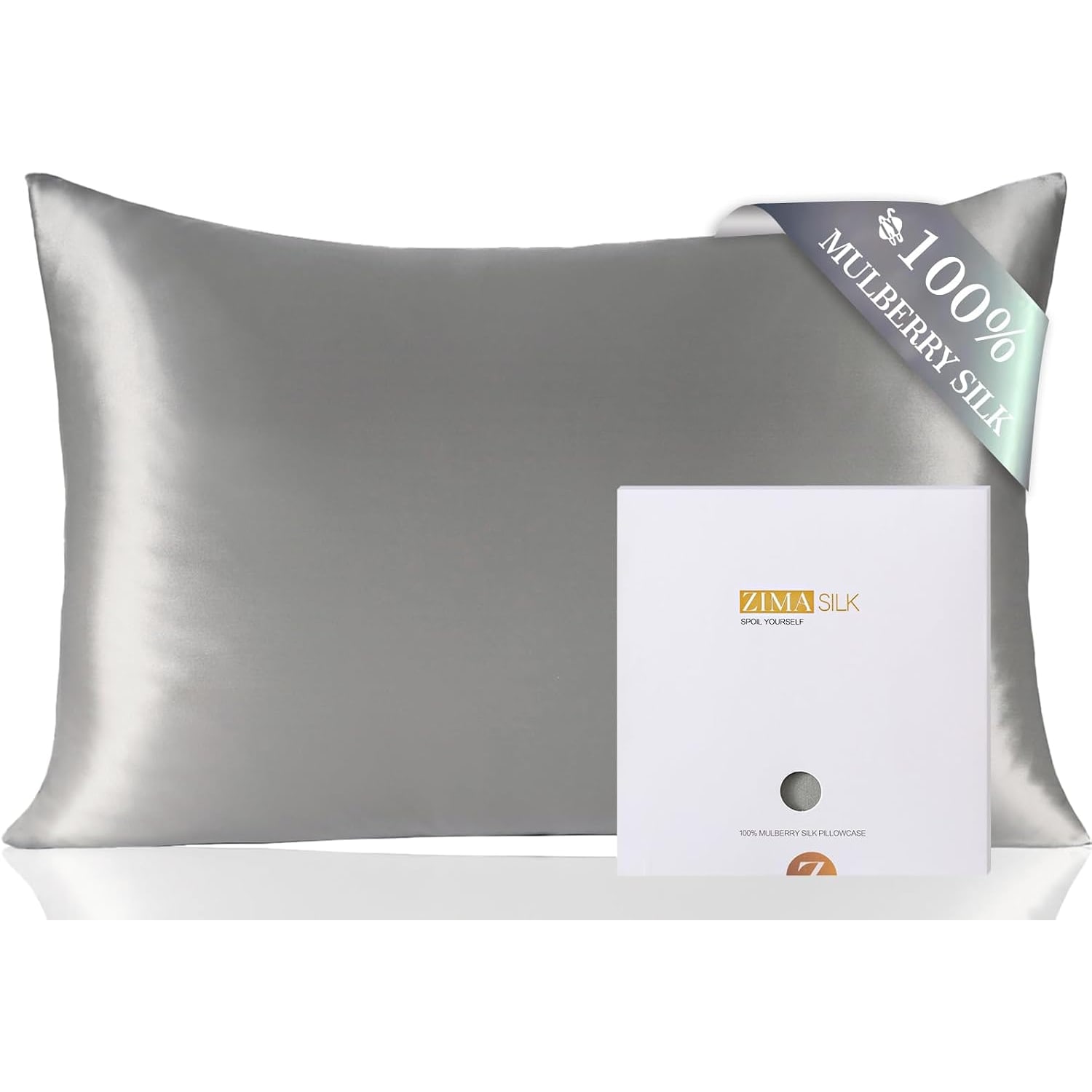
Grey is the safe choice and that is not a criticism. It is a plain solid with no pattern, no border and no trim. It sits well against white sheets, picks up charcoal and navy nicely, and does not fight with natural linen. It also hides the ordinary wear of daily use better than white does, while staying neutral enough that you will not get bored of it.
The short version
Nineteen momme, Grade 6A mulberry silk, pure on both faces, 600 thread count, plain grey, hidden zip. It measures 75 by 50 cm, which is American queen sizing, so take a tape measure to your pillow before you order. One pillowcase per pack, so buy two for a matching pair. Hand wash cool, dry in the shade, keep it away from hot irons and bleach.
Do that and you have a pillowcase that will still look good in a few years, on a bed you are slightly more pleased to get into each night.