
The complete guide
How to Choose a Silk Bonnet That Actually Fits and Lasts
The problem nobody notices until the damage is done
Hair damage at night is boring. There is no single moment where something goes wrong. You turn over, your head drags across the pillow, and a few strands get roughed up. You do it again. And again. Over months, the cuticle on each strand lifts a little more, and the result is frizz you cannot explain, ends that keep splitting however often you trim, and curls that have gone flat and shapeless by the time you wake up.
Cotton is the usual culprit. It is absorbent and the weave has a bit of grip, which is lovely for a towel and less lovely for the thing your hair spends eight hours rubbing against. If you wear braids, a weave or a protective style, the friction also works away at the edges of the style itself, so it loses neatness faster than it should.
A silk bonnet is the simplest fix. It puts a smooth surface between your hair and the bed, and it keeps everything contained in one place instead of spread across the pillow. That is the whole idea. The difference between a good bonnet and a frustrating one comes down to a handful of details, and that is what this guide is about.
What momme actually tells you
You will see momme numbers quoted on anything made of silk, and most shoppers skim past them. Momme measures the weight of the fabric, which in practice tells you how densely the silk is woven. Lower numbers mean thinner, lighter cloth. Higher numbers mean more silk per square centimetre.
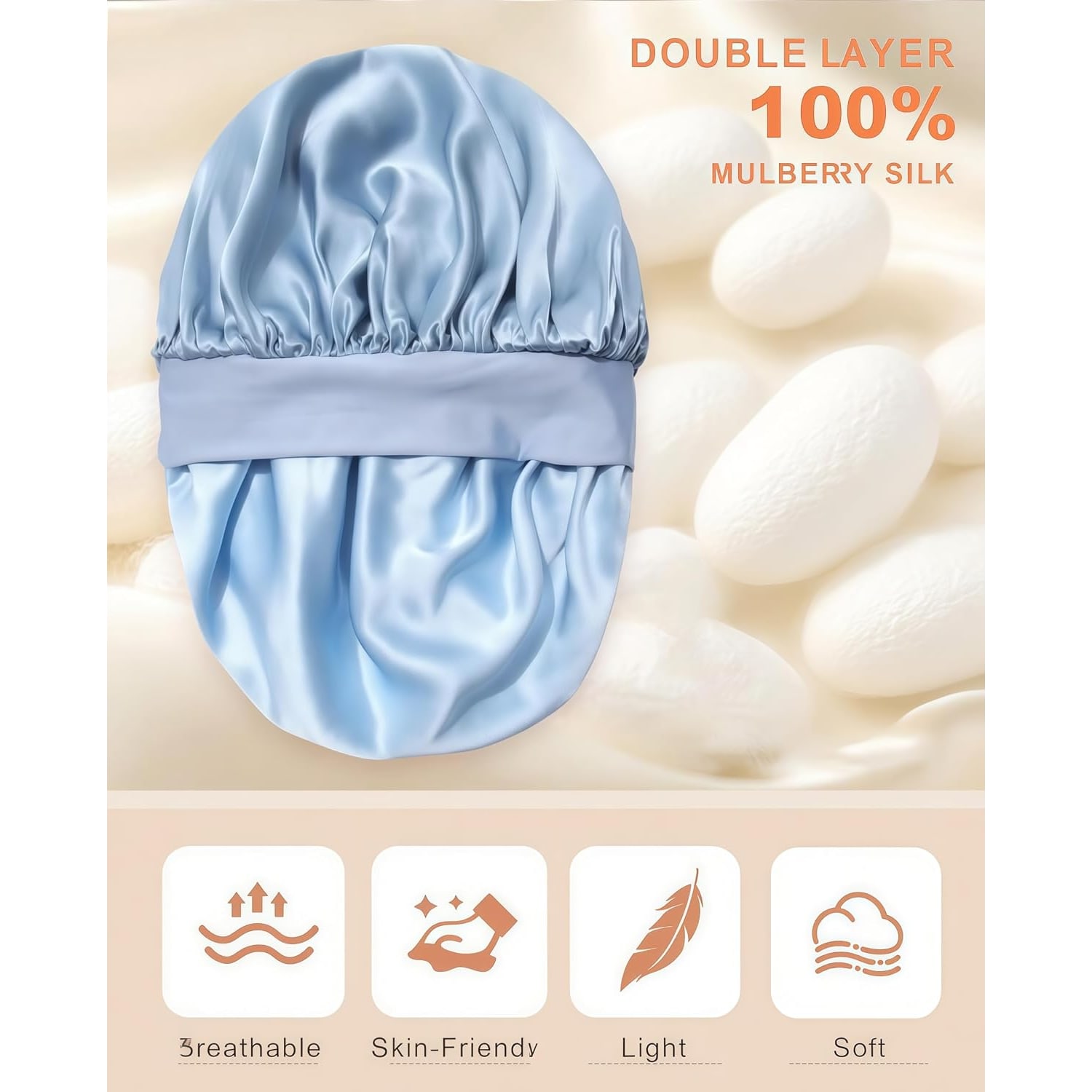
Sleep accessories commonly sit at 16 or 19 momme. This bonnet is 22 momme, which is at the heavier end of what you find in hair wraps. A denser weave feels more substantial, drapes better over a head of hair, and does not go transparent or flimsy. It is also less likely to snag.
The number alone is not the full picture though. You also want to know where the silk is. Plenty of bonnets are sold as silk when the silk is only on the outside, with a synthetic lining underneath. The lining is the part your hair touches, so that arrangement gets things exactly backwards. On this bonnet, both the shell and the lining are mulberry silk.
Why two layers instead of one
The double-layer build does two jobs. The obvious one is that the inside surface is as smooth as the outside, so hair slides on silk all night rather than on whatever was cheapest.
The less obvious job is structure. A single thin layer of silk has no body. Put it over a head of curls and it either flattens them or slides off. Two layers give the cap enough shape to sit over volume, hold a set of rollers, or cover braids without squashing the whole thing against your scalp. If you have ever woken up with a bonnet halfway across the bed, thin fabric with no structure was probably part of the reason.
Fit, and the bit people get wrong
Most bonnets are one size, and most of them achieve that with an elastic band. Elastic is a blunt instrument. It either fits or it does not, and over time it loses tension and the bonnet starts falling off.
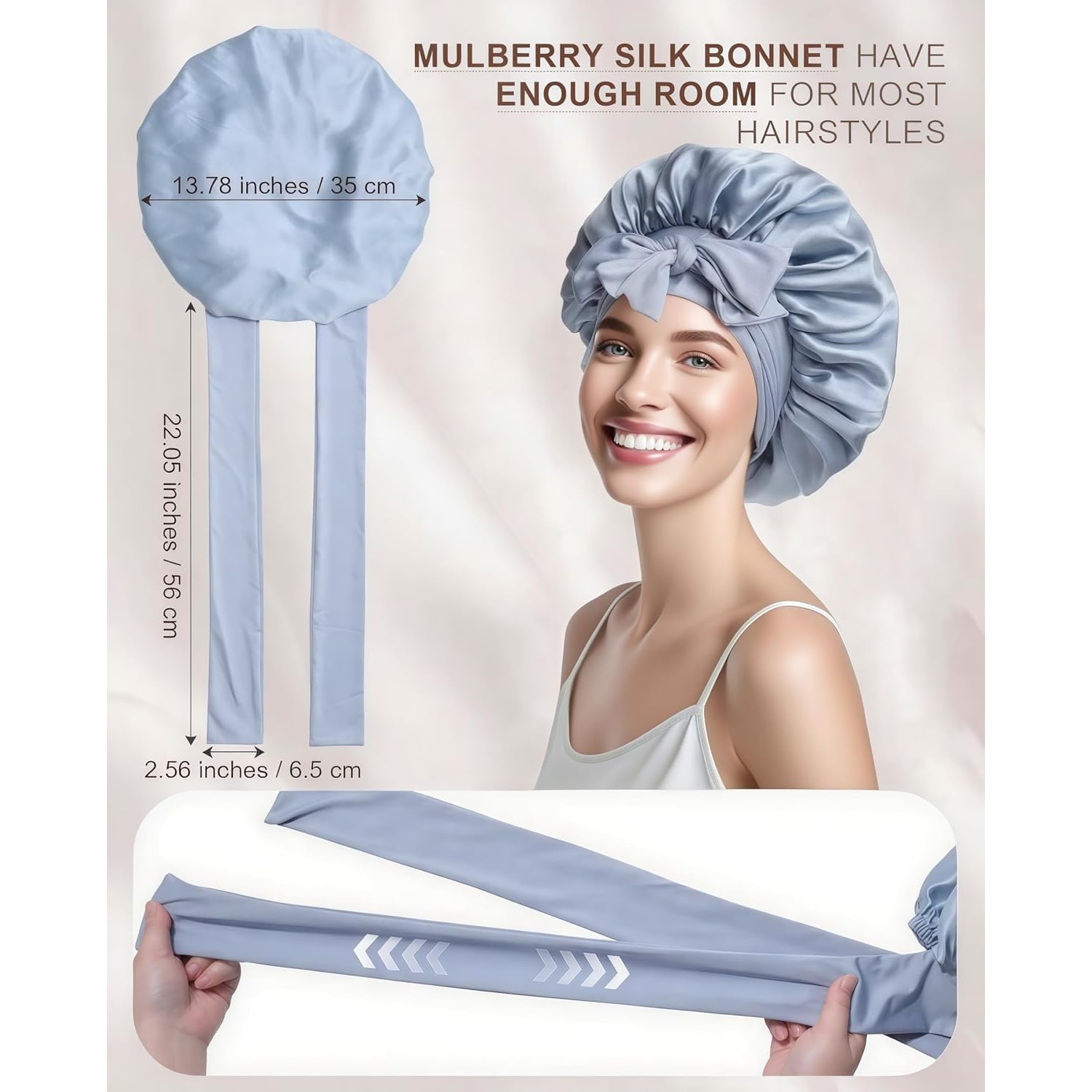
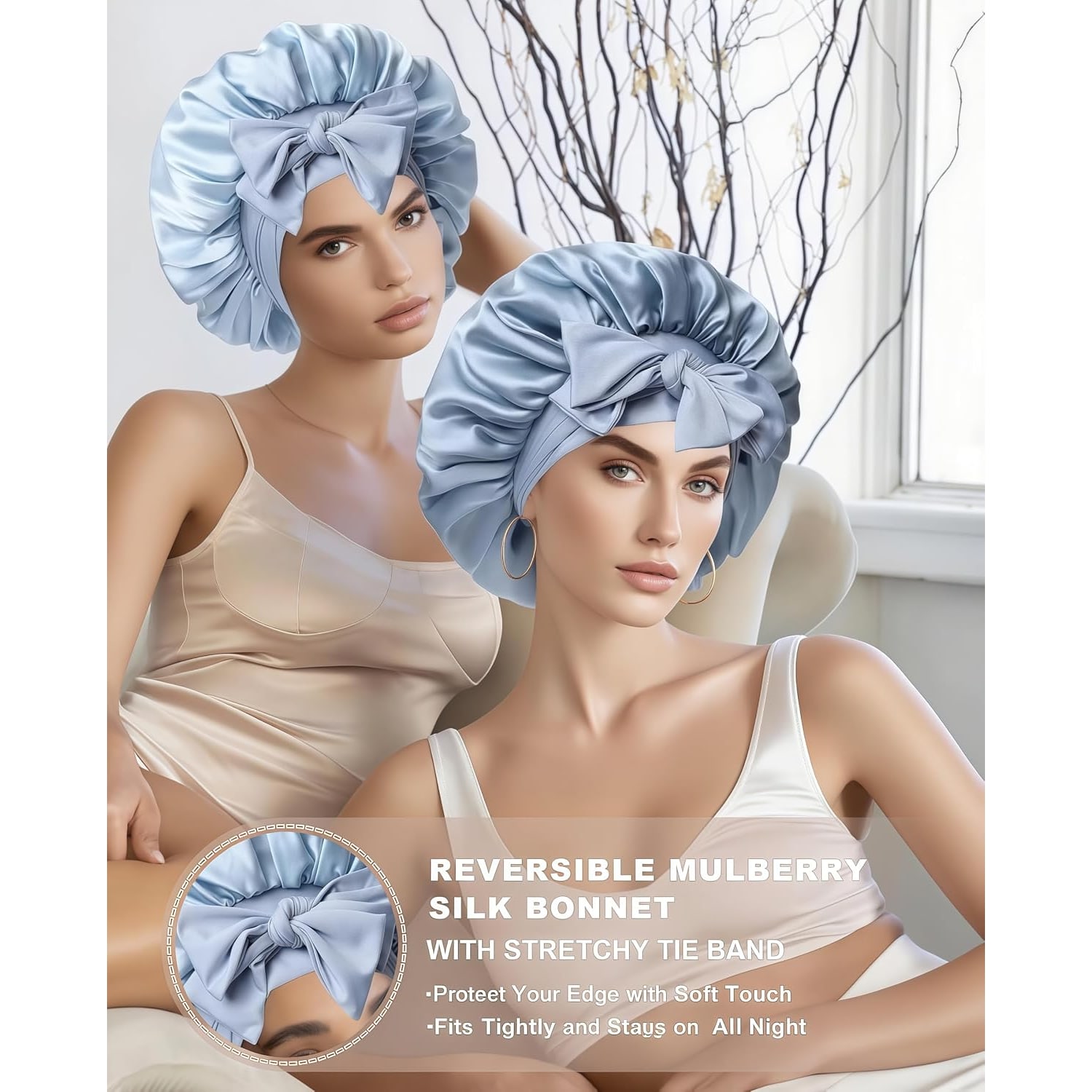
A drawstring is a better answer. You set the tension yourself and it stays where you put it. If your hair is in a smaller style one night and a bigger one the next, you adjust accordingly. The wide soft band on this bonnet also spreads pressure across a broader area of your forehead, which is the usual fix for waking up with a red line across your head.
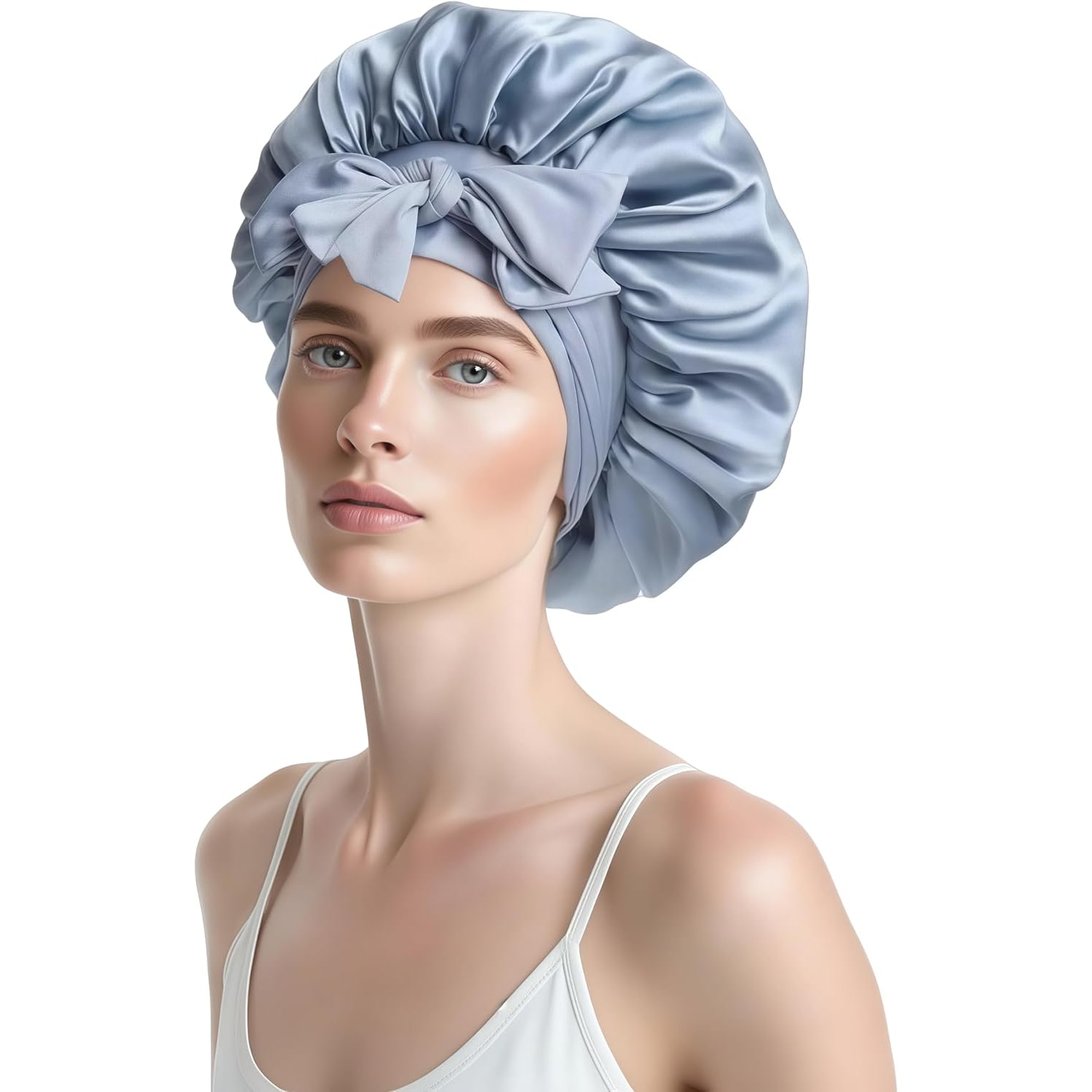
The band is long enough to tie. You can leave it flat for the plainest look, knot a bow at the front, or slide the bow round to the side. That is a small styling choice but it is the kind of thing that makes you more likely to actually wear it, including during the day.
There is one honest limit worth repeating. If your hair is both very long and very thick, a one-size bonnet may feel tight. Medium to thick curly hair is what this one handles most comfortably. A rough test: gather your hair the way you would for bed and see how big the bundle is. If it packs down to about a fist and a half, you are fine. If it is considerably more than that, you may want to braid or twist it down first.
Who it suits
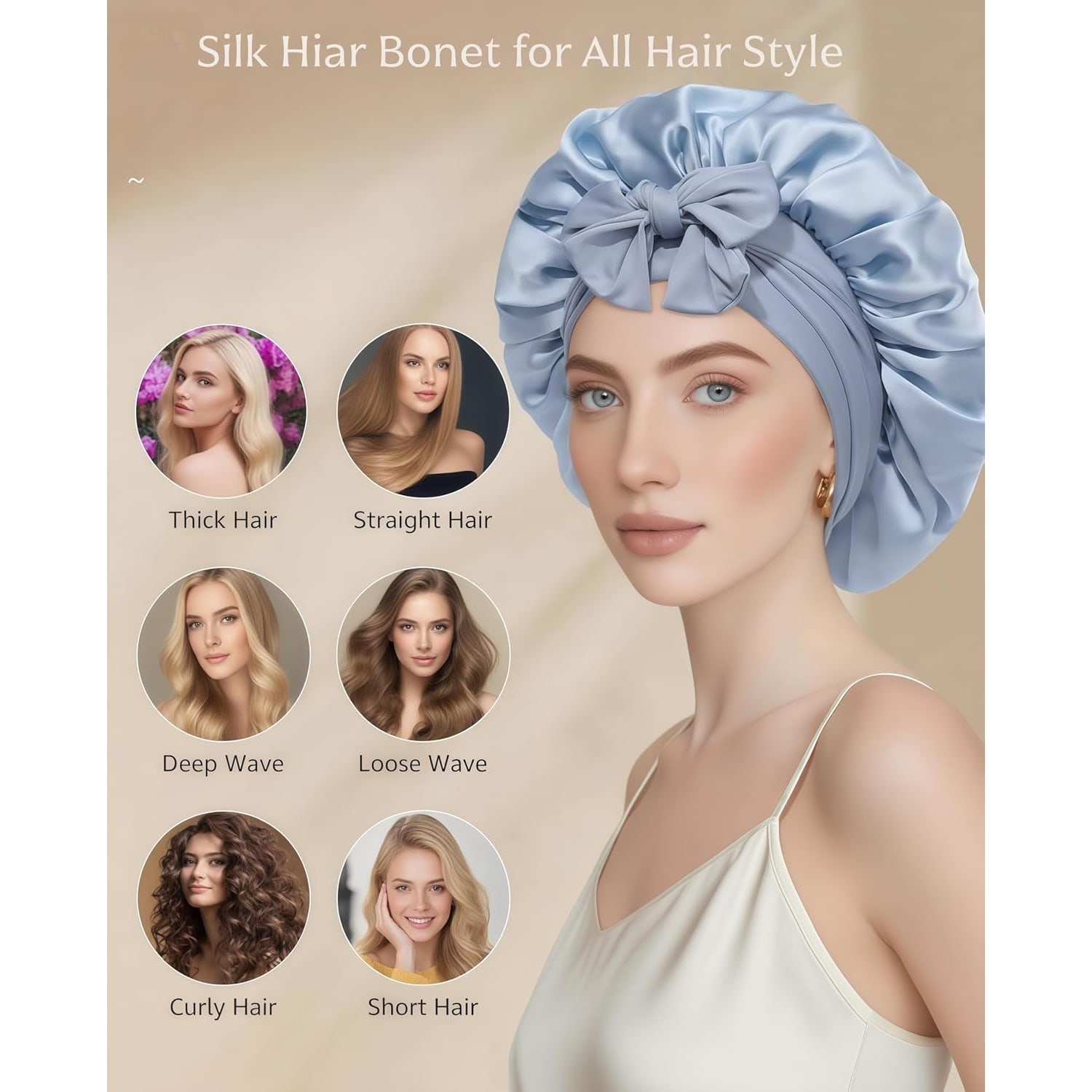
Curly and natural hair benefits most obviously, because curls lose definition fast when they are dragged around on cotton. A good silk hair wrap for sleeping keeps the pattern intact so your morning routine is a refresh rather than a rescue.
Braids and weaves are the next clear case. Protective styles take time and money to install, and friction at night shortens their life. Keeping them wrapped means fewer flyaways and a neater look for longer.
Rollers and sets are a third use. The structure of a double-layer cap is what makes this practical, since a flimsy bonnet just pushes the rollers out of position.
And then there is straight or fine hair, which people assume does not need a bonnet. It does benefit, just less dramatically. Less friction means fewer tangles.
Using it beyond bedtime
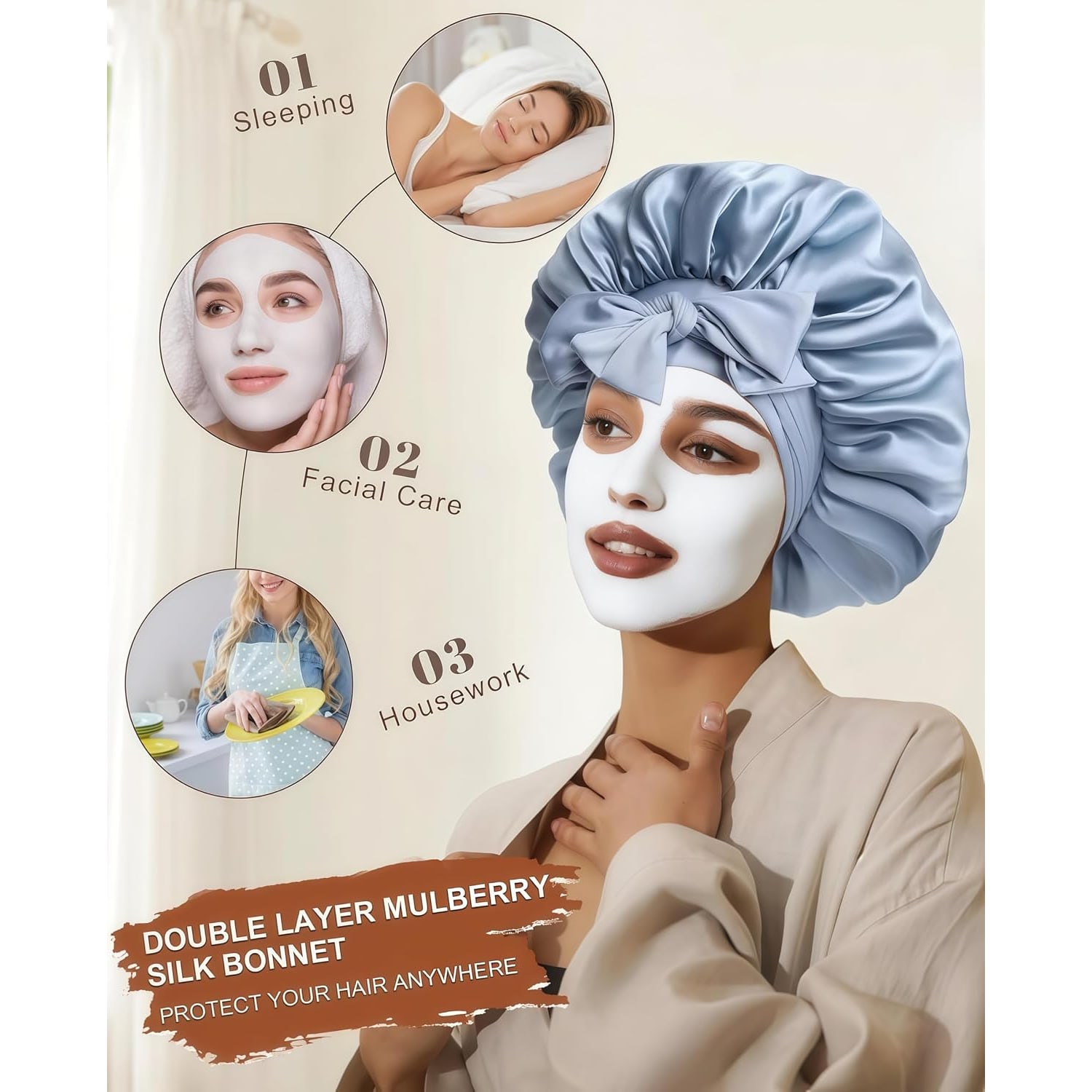
A silk cap is genuinely useful during the day. Pull it on before you wash your face and your hairline stays dry and out of the water. Keep it on through a skincare routine. Wear it while you clean the kitchen, or on the way to the gym. The sky blue is soft enough to pass as an accessory rather than something you forgot to take off.
This is also the main reason people end up wanting two. One in the wash and one in use means you never have to choose between a clean cap and a protected head.
Looking after it
Silk is not difficult, it just does not tolerate the things you do to cotton. Hand wash only, in cool water, with a detergent made for silk or wool. Ordinary laundry powder is too harsh and biological detergents are worse, since the enzymes attack protein fibres and silk is a protein fibre.
Swirl the cap gently rather than scrubbing it. Do not wring it out. Press the water out between your palms or against a towel, reshape the band, and lay it flat to dry somewhere out of direct sun. A warm radiator is not a shortcut, it is a way to make the fabric brittle.
If it needs pressing, use the lowest silk setting on your iron and work on the inside of the fabric. Most of the time, reshaping it while slightly damp is all it takes.
Wash it every week or two, more often if you use heavy oils or creams in your hair. Oils will mark any fabric eventually, so staying ahead of build-up is the easiest way to keep the colour looking fresh.
Buying from us
Delivery is tracked and reaches every province in 10 to 20 working days. It is free on orders over R1800 and R250 below that. Payment is by card only. If the bonnet turns out not to suit you, you have 14 days from delivery to cancel for any reason, as long as it is unused and unwashed, so do not put it through a wash before deciding.
The short version
Look for silk on both faces, not just the outside. Look for a momme number at the higher end, since 22 momme is denser and more durable than the common 16 and 19. Look for an adjustable closure rather than elastic, and a wide band rather than a thin one. Then be realistic about your hair volume, because the best silk bonnet for curly hair is still the one that closes comfortably around your actual hair.
This bonnet covers all of those points. Double-layer 22 momme mulberry silk inside and out, a drawstring you set yourself, a soft wide band you can tie, and a quiet sky blue that is easy to wear at any hour.