
The complete guide
How To Choose A Silk Bonnet, And What Momme Actually Means
The small annoyance that bonnets fix
Most people do not think much about what their hair touches at night. You lie down, you move around, you get up. But over eight hours you turn over a dozen times, and every one of those turns drags your hair across the pillow. On cotton, that drag has grip to it. Cotton is a short staple fibre, spun and woven, and the surface is faintly fuzzy even when it feels soft to a fingertip. Hair catches on that texture.
The result shows up in the morning. Hair that was tidy the night before is pushed in four directions. Curls lose their shape. Braids fuzz at the edges. A blow-dry that took forty minutes is flattened on one side.
A bonnet solves it a different way to a pillowcase. Instead of improving the surface under your head, it takes the hair out of contact altogether and gathers it inside a smooth cap. When that cap is made of silk, the little movement that does happen inside it happens against a filament fibre that is long and smooth, with very little to catch on.
What momme is, and why 22 is worth knowing
Fabric weight for silk is measured in momme, written as mm but said "moh-mee". It comes from the Japanese silk trade and it describes how much a fixed area of fabric weighs. In practice, you can treat it as a density number. The higher the momme, the more silk is packed into the same square metre.
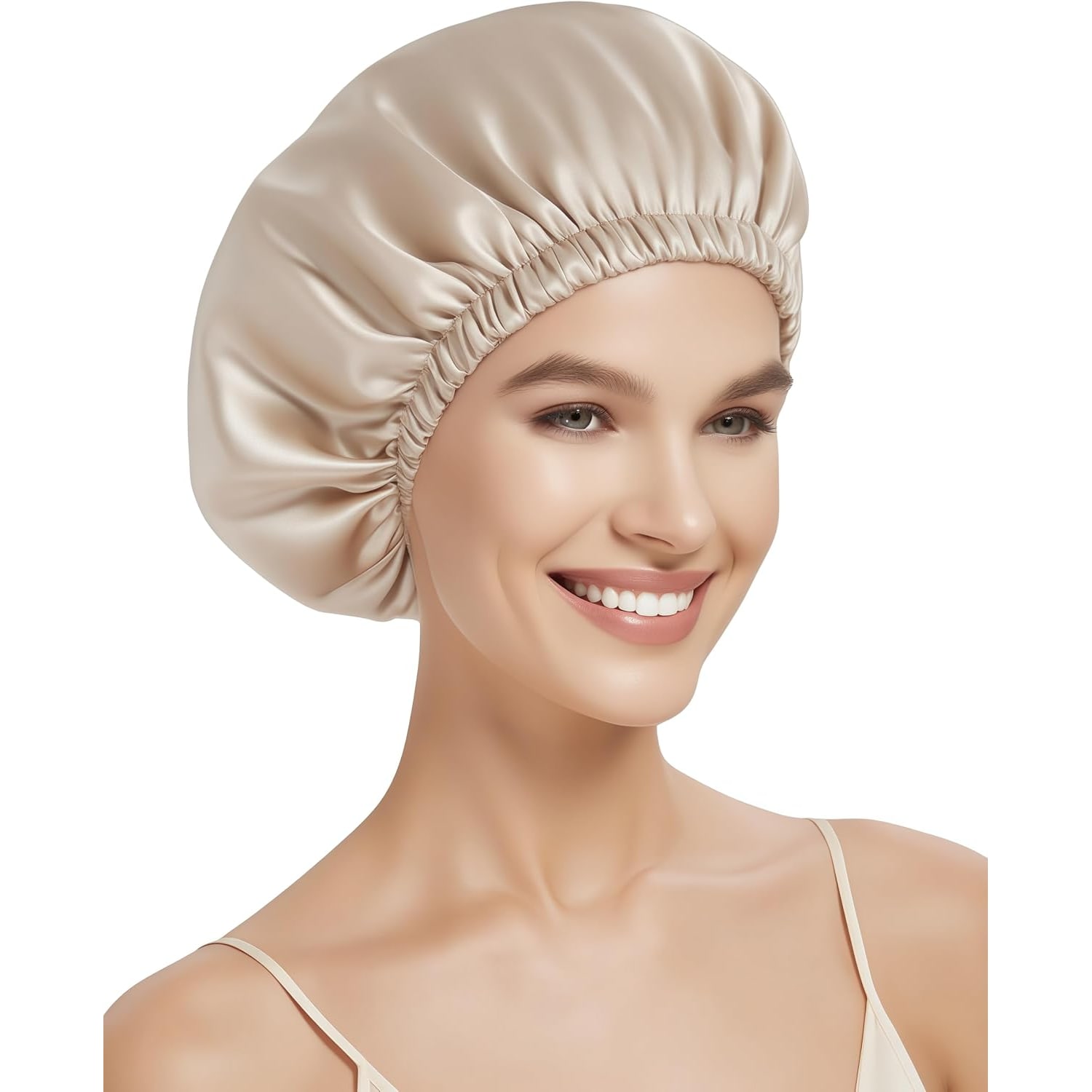
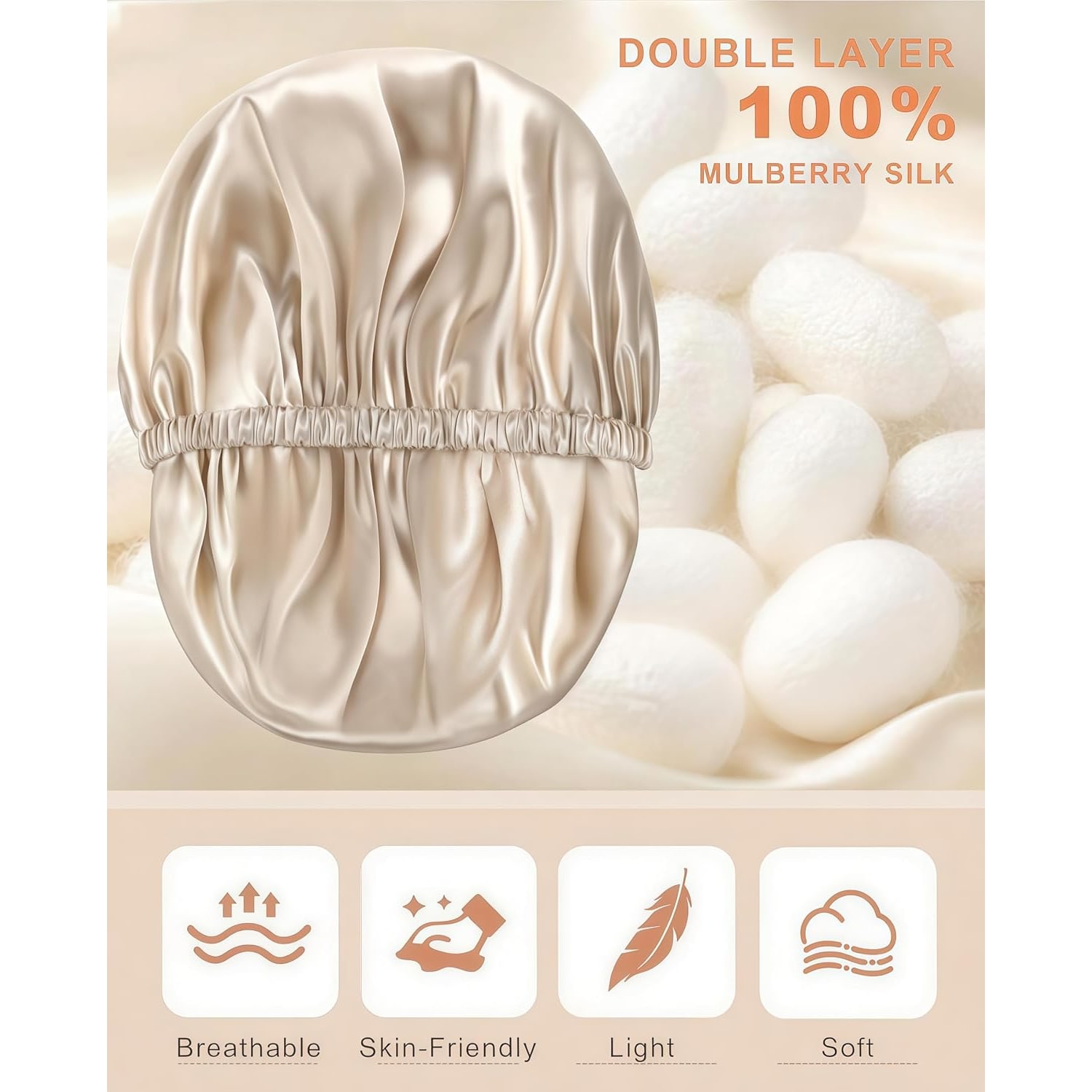
Most silk accessories sit between 16 and 22 momme. At 16 momme the fabric is light and airy and quite translucent. At 19 momme it has more presence. At 22 momme, which is what this beige bonnet uses, the fabric has real body. It drapes rather than floats. Pick it up and it has a cool, slightly weighty feel, closer to a fine lining fabric than a scarf.
There is a trade-off. Heavier silk costs more because there is more silk in it. It is also a touch warmer, though silk breathes well enough that most people notice this only in very hot weather. For a bonnet, which is small and does not cover much of you, the extra weight mostly reads as quality rather than heat.
Why double layer matters
This bonnet is built with two silk layers, with a smooth lustrous finish on both the inside and the outside. That sounds like a detail, but it changes how the thing behaves.
A lot of cheaper caps use silk on the inside and something else, often polyester satin, on the outside. Polyester satin is shiny, and at a glance it looks the same. It is not the same fibre, and it does not have the same feel or breathability. With silk on both faces you do not have to think about which side is which, and if the edge rolls over during the night your hair still meets silk.
Two layers also give the cap a bit more structure. A single sheet of thin silk collapses. Two layers of 22 momme hold a shape, which makes the bonnet easier to put on and more likely to stay where you put it.
Who a bonnet suits
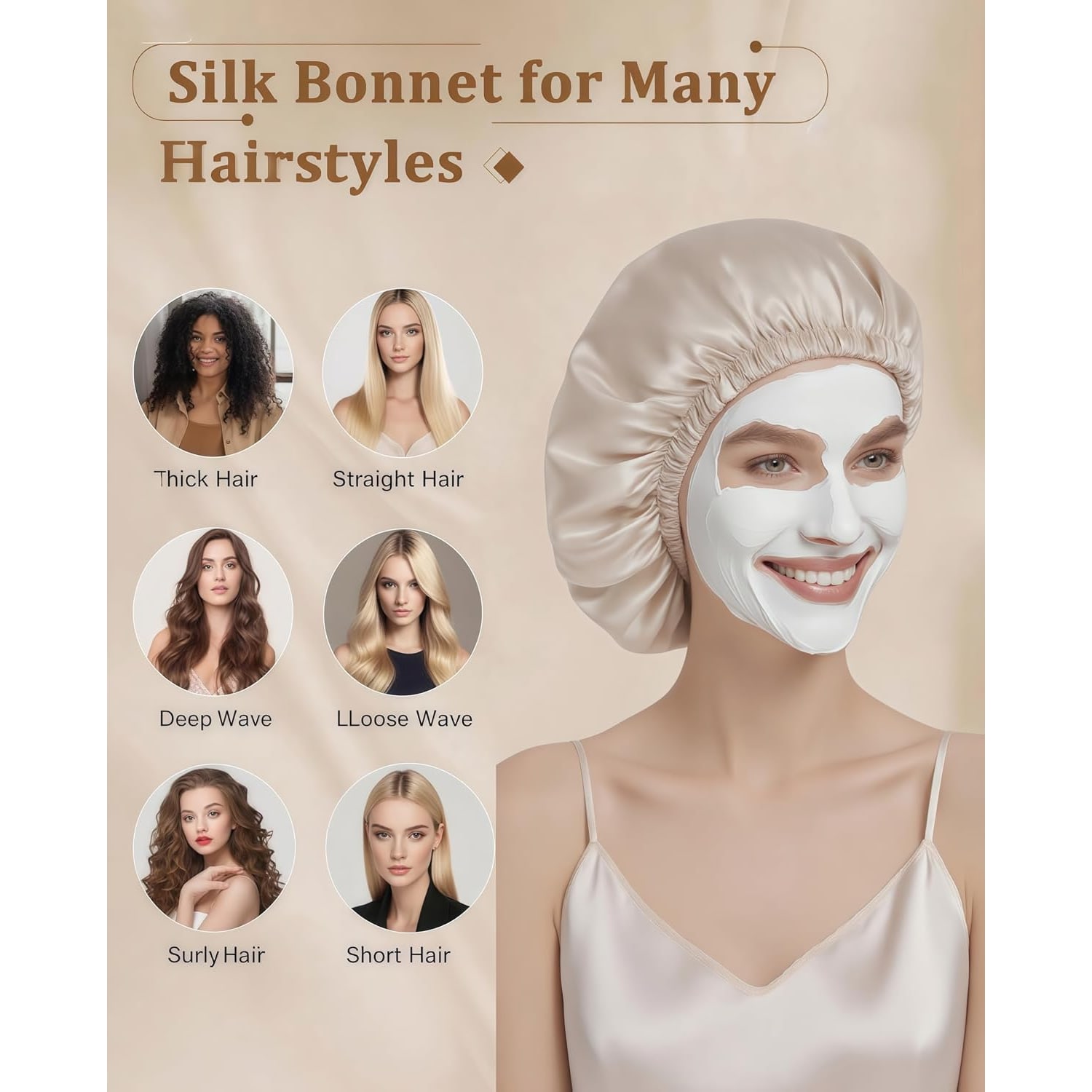
Bonnets get associated mainly with textured and curly hair, and that association is well earned. People who wear braids, twists, locs and defined curls have used caps for generations to keep a style intact between wash days. If you spend time on a style, protecting it overnight saves you redoing it.
But the use case is broader than that. Long straight hair tangles overnight too, and a bonnet keeps it gathered instead of spread out and twisted. Anyone recovering a blow-dry for a second day will get more out of it with hair contained. People with fine hair that knots easily often find a cap reduces how much detangling they do in the morning.
It is also useful at other times of day. Pulling hair back and out of the way while you cleanse your face, apply skincare, or make breakfast is a small convenience that people end up using constantly. The best silk hair wrap is often the one that ends up on the bathroom shelf as much as the bedside table.
Who it suits less: if you have very short hair and no particular style to protect, a bonnet may not do much for you. A silk pillowcase might be the better spend, because it improves the surface against your face as well.
How to choose between a bonnet and a pillowcase
This question comes up a lot, so here is the honest answer. They are not competitors, they are different tools.
A bonnet contains hair. It is the better choice when you have a lot of hair, when you have a style you want to preserve, and when you want everything gathered rather than loose. It travels well, it costs less than a full pillowcase, and it works on any bed you happen to be sleeping in.
A pillowcase improves contact for your face and your hair at once. It needs no fitting and nothing to put on. It is the easier habit to keep, because you do not have to remember anything.
Plenty of people use both. The bonnet holds the hair, the pillowcase handles the rest. If you only want one to start with, pick based on whether your main concern is your hair or your skin.
Fit and comfort
Bonnets are generally cut roomy on purpose. The point is to let hair sit inside without being compressed, because compressing curls flattens them and compressing braids creases them. If a cap feels tight, it is probably too small.
The finished head sizing is not stated by the maker for this bonnet, so think about how much hair you need it to hold. If your hair is very long or very voluminous, consider whether you will need to twist or pin it up before putting the cap on. Many people do this anyway as part of their routine.
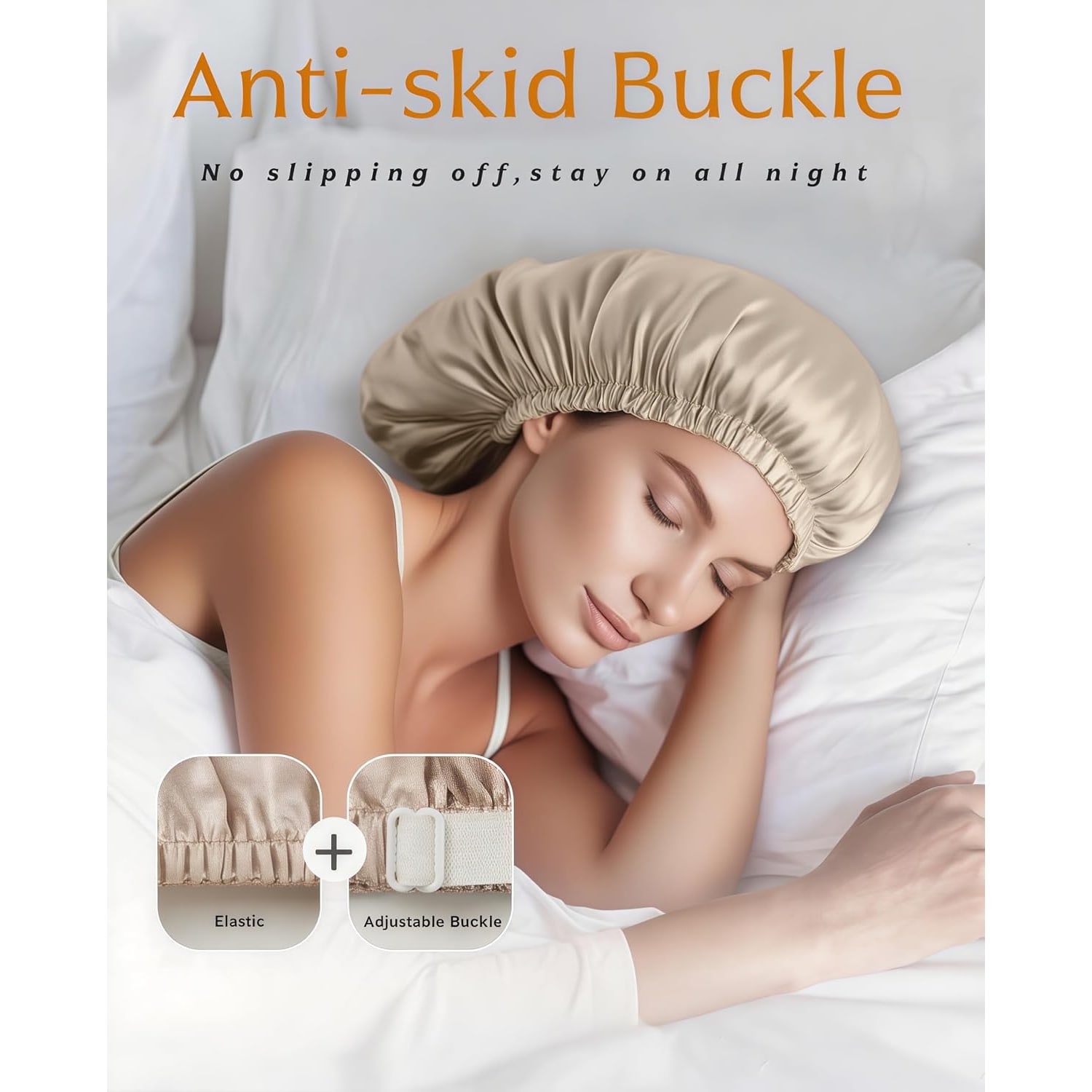
Comfort at the band matters more than people expect. An edge that grips too hard leaves a line on your forehead and can feel tight after an hour. A looser edge is more comfortable but may slip off during the night. There is no perfect setting, only the one that suits your head and how much you move.
Looking after silk
Silk is tougher than its reputation suggests, but it does not like heat, bleach or rough handling. Those three rules cover nearly everything.
Wash by hand in cool water with a detergent made for delicates. Swirl it, do not scrub. Rinse it properly, because leftover detergent dulls the surface. Press the water out between your palms or against a towel, and do not wring or twist it, because that stretches the weave.
Dry it flat, or hang it somewhere shaded. Direct sun fades dye and weakens the fibre over time. Skip the tumble dryer entirely. If it needs a press, use the coolest iron setting on the reverse side.
Wash frequency depends on what you put in your hair. Oils, leave-in creams and styling products transfer onto the silk and will eventually make it look flat and feel slightly tacky. If you use products nightly, a weekly wash keeps things fresh. If your hair is dry and product-free, you can stretch it longer.
One practical warning. Fine silk snags on the things you would expect, like rough fingernails, jewellery clasps, hooks and Velcro. Store it somewhere soft rather than tossed in a drawer with hairpins.
What the beige gets you
Colour choice in accessories is usually about how much attention you want the thing to attract. A solid beige silk bonnet attracts almost none. It sits on a bedside table without looking like clutter, it does not clash with bedding, and it does not look tired after months of use the way a bright shade sometimes does.
It also makes it an easy gift. You are not guessing at someone's taste in prints, and there is no sizing problem of the sort you get with clothing. A neutral pure silk cap is one of the few accessories you can hand to almost anyone.
The short version
This is a beige bonnet in 22 momme mulberry silk, built in two layers with silk on both faces. The higher momme makes it denser and fuller than the lighter silks that dominate the shelf. The double layer means your hair meets a smooth surface whichever way the cap sits.
It will keep long, curly, braided or styled hair gathered overnight instead of spread across the bed, and it will do the same job in the morning while you wash your face. Wash it cool by hand, dry it flat, keep it away from heat and sharp edges, and it will stay smooth for a long time.
If you are weighing it up against a silk pillowcase, choose the bonnet when hair is the priority and the pillowcase when skin is. Plenty of people end up with both, and that is a perfectly reasonable place to land.